Don't Surcharge Your Best Customers

Diesel costs have risen sharply across the USA and Canada in 2026, and every distributor running a delivery fleet feels it. The obvious fix is a blanket fuel surcharge on every order. It's quick to set up and easy to explain. A recent Bubo AI analysis of a parts distributor shows why it can damage your most valuable customer relationships.
Who's really behind the small deliveries
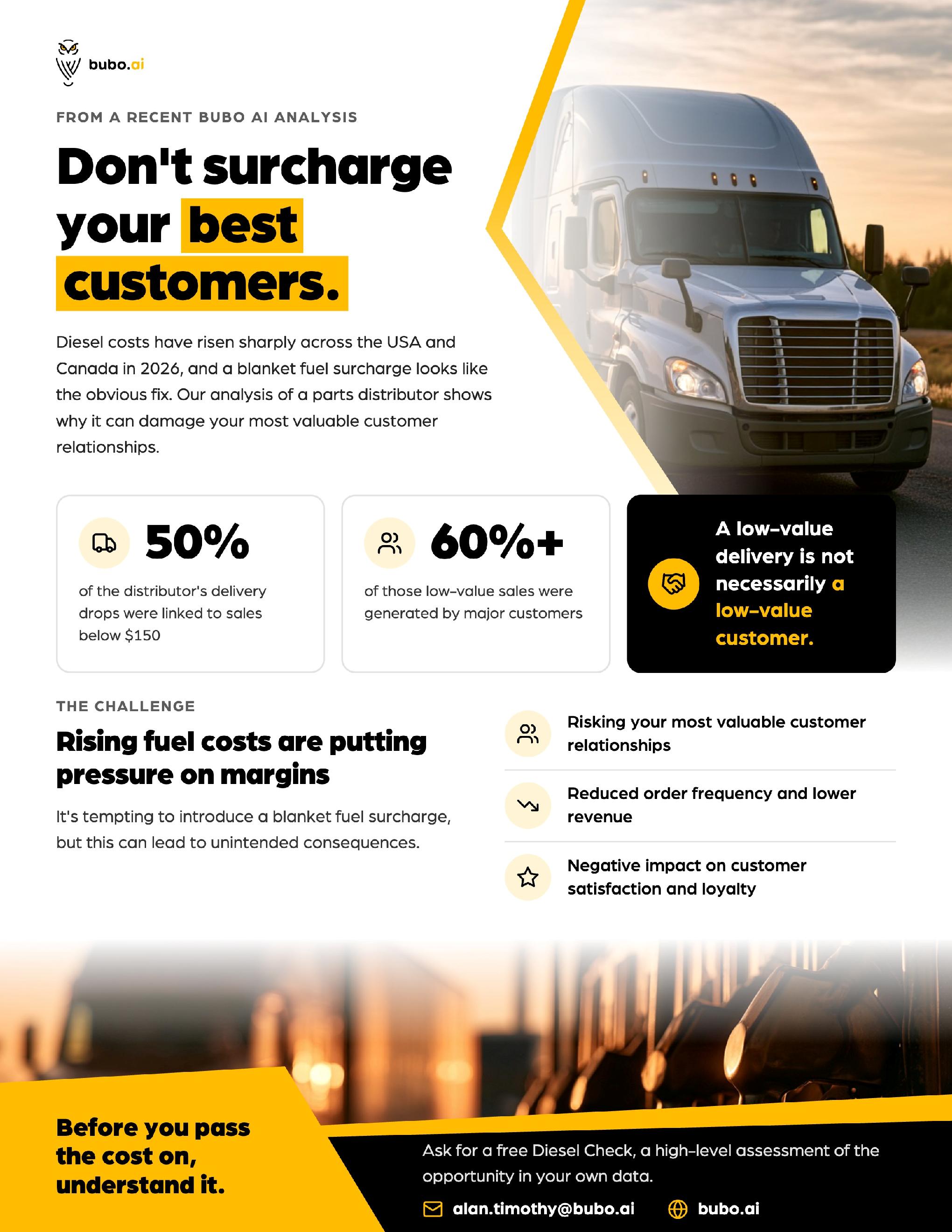
Half of that distributor's delivery drops — 50% — were linked to sales below $150. That looks like a cost problem. But more than 60% of those low-value sales were generated by major customers. The accounts placing the small orders weren't the occasional buyers. They were the customers the business depends on most, and a blanket surcharge would have landed hardest on them.
A low-value delivery is not necessarily a low-value customer.
What a blanket surcharge costs you
Pass the full fuel cost to everyone and the consequences show up later: your most valuable relationships put at risk, reduced order frequency and lower revenue, and a hit to customer satisfaction and loyalty. Before you pass the cost on, understand it.
Six steps to a better response
1. Quantify the real impact. Turn the diesel increase into cost per delivery, route, customer and order.
2. Find avoidable delivery cost. Look for low-value drops, repeat weekly deliveries and low-revenue routes.
3. Protect the customers that matter. Judge the whole relationship rather than the value of a single order.
4. Optimize before you surcharge. Consolidate drops, schedule delivery days and set minimum order values.
5. Target surcharges. Match the response to each account instead of one rule for everyone.
6. Measure the outcome. Track cost savings alongside margin, retention and service.
The Takeaway
Rising fuel costs are real, but one rule for every account isn't the answer. The data on who drives your delivery cost — and who's worth protecting — is already in your system.